


Page 32 - 2019 Annual Report Hsinchu Science Park
P. 32
30 Hsinchu Science Park 2019Annual Report Diversify uses of sensor ICs,
capitalize on novel applications
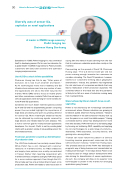
A leader in CMOS image sensors/ PixArt Imaging Inc.
Chairman Huang Sen-huang
   Established in 1998, PixArt Imaging Inc. has committed itself to developing sensor ICs for over two decades. As a global leader in CMOS image sensors, PixArt provides customers with SoC total solutions and optimized imaging analysis services.
Use AI, 5G to unlock infinite possibilities
Chairman Huang has this to say: “After years of evolution, AI is now much smarter and faster.” As AI technologies make more headway and 5G infrastructure matures over time, any number of user- end applications are set to find their way into the market. While IDMs tend to focus on mobile phone and other mainstream markets, PixArt has set eyes on vertical applications while striving for niche markets for novel AI and 5G applications.
Combined, the much faster internet speed accorded by AI and 5G and the exponentially greater computing power thus accorded highlight the importance of edge data processing and point to growing demand for sensor ICs. More meaningful analytical results can be obtained by combining signals received by edge devices and related data for joint analysis. This is now a common goal for many end-user applications developers. For its part, PixArt is set to provide global clients with a greater variety of value-adding sensor ICs and related services.
Trade war, pandemic to speed up diversification of production sites
The U.S.-China trade war has certainly caused jitters. While PixArt has a unit charged with customer relations in mainland China, its R&D endeavors and supply chain partners are mostly concentrated in Taiwan. Rather than rejecting cooperation with mainland Chinese companies outright, PixArt has opted for a more cautious approach. Even though the U.S.- China trade war has only a limited direct impact on its production side, PixArt still needs to exercise caution in
coping with the indirect impact deriving from the fact that its customers undertake production mostly on the mainland.
Commenting on the spread of Covid-19, Chairman Huang says: “The U.S.-China trade war did not prove a strong enough incentive for customers to consider relocating. The Covid-19 pandemic, however, started our customers thinking about geographic diversification.” Indeed, this pandemic has heightened the risk alertness of companies worldwide that may lead to reallocation of their production capacities. The combined effect of the trade war and the pandemic is likely to be felt as a wave of industries moving away from mainland China.
Stand unfazed by China’s takeoff, focus on self- upgrading
PixArt is not daunted by an increasingly competitive environment where Chinese industries are growing at breakneck speed. Chairman Huang stresses: “Taiwan’s solid foundation in the semiconductor industry built up over the years is our most formidable weapon.” Having committed itself to sensor ICs development for more than two decades, PixArt will hold on to its leading edge by focusing on bolstering R&D capability and applying its core technologies to a wide range of products— wearables, TWS earphones, security devices, and gaming mice—among others.
“Taiwan can never follow the pattern of China’s funneling massive government resources into the semiconductor industry,” Chairman Huang says. “But precisely because of this PixArt has developed a pragmatic way of doing business and concentrated on making itself stronger.” In the days ahead, PixArt is set to stay focused on image sensor development while also striving for diversification of sensor applications. As such, the company will draw on its superior core technologies to prevail in the market for emerging applications going forward.


